
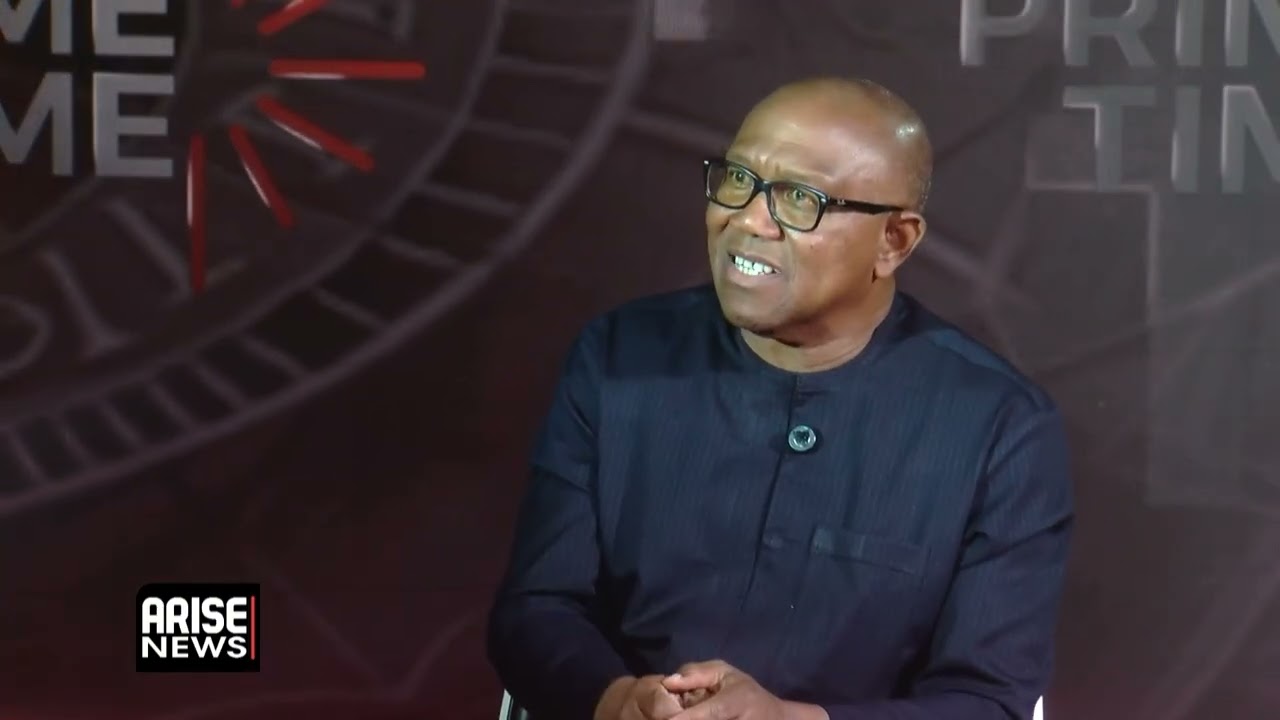

Former Governor of Anambra State and a chieftain of the African Democratic Congress, Peter Obi, has insisted that the ADC convention will go ahead as planned, regardless of warnings from the Independent National Electoral Commission, (INEC), and internal disputes within the party.
He also accused the current government of failing to adhere to democratic rules.
Speaking in an exclusive interview with ARISE NEWS on Monday, Obi confirmed that the convention of the ADC would take place in Abuja as scheduled. He alleged that the party had been denied access to major venues, including the Eagle Square and the Moshood Abiola National Stadium, accusing the government of undermining opposition parties and failing to play by democratic rules.
“Definitely. It will hold tomorrow (Tuesday). In Abuja here. It’s going to happen in Abuja. And I’m sure ARISE will cover it. It will definitely hold.
“That shows you the integrity of our democracy. If you’re denied simple things like venues and everything, it shows where the country is drifting to. When we have freedom of association, everything enshrined in our constitution, and yet a party that is supposed to be the main opposition party cannot be allowed to exist.
“The government doesn’t want other parties to exist. They’re not playing by the rules,” he alleged.
Responding to questions about the venue denials, Obi said he did not know the exact reasons given for rejecting the party’s requests. However, he stressed that unless the party in power allows institutions to operate independently, such challenges could persist for the ADC.
“I don’t know, just like you. I don’t know, but I believe that unless the party in power decides to support our institutions to be able to play their part, we’ll continue having such problems,” he noted.
Speaking on ADC’s leadership dispute involving David Mark, Obi cited existing court rulings which, he said, prevent INEC from interfering in the internal affairs of political parties. He argued that the rulings should have settled the matter, but accused the current government of worsening the crisis and undermining the system.
“There have been decided cases clearly that say that INEC, as a regulatory body, should not—that nobody should interfere in the internal affairs of political parties. It’s some decided cases, which ordinarily would have been enough, but because the present government is bent on destroying the entire system, that’s why we’re going round and round.”
Reacting to the court dispute, Obi said he was unsure if the Federal High Court would defer to the Supreme Court. He, however, criticised the judiciary and accused those in power of weakening democratic institutions.
“I don’t know. I don’t get involved with that because I believe it is wrong. Government in office should ensure they protect opposition. In fact, they should make opposition stronger, make it work. Look at what has happened to our democracy. It’s now being destroyed. And it’s being destroyed by those who yesterday were victims of the same, similar thing and were shouting to the world. Nobody would have believed that today we’ll be where we are in this democratic process, considering the actors who are involved in governance today,” he said.
Addressing concerns over his political emergence from the PDP to Labour Party, Mr Obi clarified that the Labour Party presidential primary was held in Asaba and included other aspirants. He noted that some candidates stepped down voluntarily, adding that he would return to the issue later.
“No, the primaries in Labour Party, clearly, it was held in Asaba. There were other aspirants. Yes, most of them stepped down for me. I mean the ones who could put up a challenge. And they gave their reasons. Anyway, I’ll come back to that issue.”
Explaining his decision not to take part in the PDP primary, Obi said he opted out because he believed the process was flawed.
“I didn’t participate in the primary in PDP because I saw it was going the wrong direction. When you’re in a system where people don’t play by the rules and you believe in the rules, the only way to do differently is to leave. And that remains my position yesterday, today, and tomorrow,” Obi stated.
Commenting on the INEC’s withdrawal of recognition from the ADC leadership, the Former Presidential Candidate described the move as wrong, questioned its reversal, and alleged political interference, saying the matter is before the courts.
“They’re wrong. And it’s even something one can’t imagine. Because they recognized yesterday. So, what’s so sudden now that brought about their reverse? Somebody is pushing them to do that,” Obi alleged.
Referencing a past dispute in the All Progressives Grand Alliance under former President Umaru Musa Yar’Adua, Ralph Nwosu argued that governments should strengthen opposition parties even when court cases are ongoing.
“I’ve said it before. Everybody knows. I just gave you an example. That when we had a problem in APGA, President Yar’Adua decided, ‘I don’t want this.’ Even when the case was in court. And that was the end of it. A government that wants progress will support strong opposition. Because it’s critical,” he emphasised.
Confirming the planned event, the ADC member said the ADC would proceed with its national convention on Tuesday, describing the action as a response to what he called a “wrong decision” and added that he would be in attendance.
“Because we believe that what they did is wrong. Definitely, I’ll be there,” he assured.
He added that the ADC convention, which began with earlier congresses, would be concluded as planned.
“We’ll ensure that that convention, which started with the congress, comes to a conclusion.”
On the ADC’s next steps, Obi said the ADC would wait for any decision by INEC before determining its response, adding that outcomes remain uncertain given the current political environment.
“Let’s see what happens when they take their decision. Then we’ll know where to go. Because you’re hoping that the Supreme Court will rule in your favour. Let’s see what happens. These days, nobody plays by the rules today now. So, you can’t be sure of what is going to happen,” he said.
Responding to questions on his political future, Obi said the issue was not about personal ambition but the integrity of the democratic process, stressing that his actions are aimed at building a better society and warned that current developments were weakening the foundations of democracy.
“It’s not about me. It’s not about anybody. It’s about the integrity of our democratic process. Indeed. It’s about society. It’s about building a better society for us and our children. It has nothing to do with me personally.
“I’ve never done things or pursued everything, believe in my own ambition or just for me to be true, but I do it believing that it will help to build a better society. And everything they’re doing—whatever they’re doing—is destroying the fabric, the foundation which we need for a better society,” he warned.
Speaking on growing defections of individuals into the ADC, Obi noted that new members were joining because they believed the actions of INEC were wrong, adding that the party is building a broad opposition coalition ahead of the 2027 elections.
“Because they know that what you’re saying or what INEC is doing is wrong. We have said we want all oppositions to come together to build one strong coalition, because election in 2027 will be the government in power versus the people. So, we are now coming to stand for the people,” Obi declared.
Speaking further on concerns over internal disputes in the ADC, Obi argued such challenges are externally instigated and aimed at weakening opposition parties.
“The problems within ADC or other political parties are problems instigated, supervised, and controlled from external forces, which is government. Deliberately to destroy them, investing heavily in it.”
Adding, Obi said he and others are committed to confronting issues in the political system, insisting they are determined to dismantle entrenched criminality.
“That is exactly what I’m fighting, and there are a number of people with me who are fighting the same cause. We must dismantle this criminality that exists today,” he insisted.
Addressing concerns over his party movements in recent years, Obi said his switches between parties were driven by disagreements, internal crises, and opposition to transactional politics, adding that he moved to avoid destructive situations and systemic failures.
“I moved from APGA to the PDP because I had what I can call disagreements or issues with my successor, the governor who came after me. And not to allow it to become toxic and become destructive to the governance of the state, I moved out. In PDP, I said it before, people were not playing by the rules. It was transactional. I cannot be part of transactional primaries. I cannot be paying people to go and serve them. I moved to Labor. And of course, as I said, government came into the same system, which is very clear.
“I’m in ADC with the same people, some of whom I left in PDP and other parties. But we are going through the same process. If that process is again compromised, I will speak out. But what is important is not what people are yesterday; it’s what they are today. Because they’ve seen that what is going on—and they can decide no, we are making this sacrifice, we will no longer go back to what we used to be,” he explained.
Speaking more on his frequent party movements, Obi maintained he would continue to move if necessary, arguing that he cannot advocate change while remaining in a flawed system.
“I don’t have long time in politics, but if I have long time, I have to do it 20 times, I will do it exactly. I cannot be talking about change, I cannot be talking about something new while being part of the same thing. You cannot use the process of yesterday to build tomorrow.”
He denied any involvement in electoral malpractice or inducement of judicial outcomes and insisted he has always operated within due process.
“I’ve never been involved in any form of rigging of election, at primary level, at the election itself, and after that. But I cannot be preaching change and doing the same thing,” he maintained.
Responding to questions about securing the party’s ticket, Obi said the focus of the ADC is a broad coalition of competent and committed individuals rather than individual ambition, stressing the need for sacrifice and collaboration to address Nigeria’s challenges.
“We are a coalition. For me, what I believe that Nigeria requires now is a coalition of people who are willing to sacrifice everything. It’s a coalition of competencies, coalition of capacities, coalition of people who are compassionate to tackle issues that Nigeria needs urgent attention today. That’s the primary idea of that coalition. We are no longer going to be a coalition of people who are going to share democratic dividends or transactional coalition, because there’s nothing to share any longer. Our recruitment process for 2027 must be different from what it used to be. We must now get somebody who is committed to a future and a better Nigeria,” Obi said.
He added that the decision on leadership within the ADC would be collectively made by the party, based on clear and verifiable evidence of competence, adding that selection must prioritize the most capable candidate.
“Like I said, we have a party now. I’m sure the party people will come together and decide. There might be somebody better. There might not be. But whatever is the choice, it must be based on empirical, verifiable evidence that this person is better.”
Speaking on his recent meeting with Rabiu Kwankwaso, Obi said it forms part of a broader coalition effort aimed at national unity, stressing the need to move beyond religion and ethnicity in building a secure and united Nigeria.
“It’s part of the alliance. Part of the coalition. One of the things that is affecting us today in this country is lack of unity. We need now to be united as a country. We have to now ensure that religion, tribe, does not exist in building this future we want. We need united, secure Nigeria where we can start conversing and discussing issues that will help us to build a better future,” he urged.
Reacting to concerns about his chances in the North in the coming elections, Obi said he would work with allies like Rabiu Kwankwaso and Nasir El-Rufai to reduce poverty in Northern Nigeria.
“I’ll work with them so they can do that. Nobody will build or do what I intend to do in the North. I’ll change the North. I’ll create assets in the North. I’ll create assets that the country has in the North. The vast uncultivated land is our future. We can make more money as a country from agriculture than we make from oil. And that we have to start doing immediately. If we want to secure the North today, we need to start investing in those critical areas: agriculture, pulling people out of poverty, investing in education, investing in health. And that we can do,” Obi stated.
On matters of insecurity in Nigeria, especially in the North, he said it requires decisive action, recalling his experience tackling crime in Anambra State through collaboration with federal authorities.
“Of course, when you talk about securing the North, it’s just like securing all over Nigeria. When it comes to issues of security, we’ve reached a stage where we have to be very, very decisive. No longer an issue of negotiation or anything. I had what I can call disturbing insecurity when I became the Governor of Anambra State. It got to the stage that I had to call near and top President Obasanjo: ‘Mr. President, this is what I want to do and you must allow me to do it,” he recalled.
He added that insecurity is rooted in long-term governance failures and called for stronger institutions, justice, and restoration of public trust.
“It started with the erosion of governance, erosion of values, abandoning the youth, no education, trust, social trust, everything. What you’re seeing now is the cumulative effect of leadership failure over the years that brought us to this. What you need to do is to be decisive and then start a long-term process of ensuring that you build trust, you bring governance, justice. No nation will lose about ten of its senior officers and not declare war; I would declare war,” Obi stressed.
Speaking on political alliances and support, Obi said he would continue touring the North, stressing that the region is central to any national leadership ambition and engagement.
“I’m going to be in the North. I’m going to be in the North. If there’s anywhere any leader should be touring today, it is the North.”
Commenting on the detention of Nasir El-Rufai, Obi described it as political persecution and called for due process, insisting that investigations should follow legal procedures rather than public drama.
“It is political persecution any time, any day. There should be civility and order. A person can be investigated; if you think there’s mismanagement of money belonging to Kaduna State and you’ve done your investigation and followed the trail and see where the money went and everything, you go to court, prove your case, and have the money refunded. You do not have to start running up and down, creating issues and all that. It doesn’t make sense. Most of these things we’re doing—this drama we’re doing in saying we are pursuing corruption—for me, it’s nonsensical,” he said.
Obi further reiterated his commitment to fighting corruption in the country.
“I’ve said to everybody, I will fight corruption to where it will be very, very minimal.”
Speaking on his first policy priorities if he emerges President in 2027, Obi said he would take decisive action on insecurity and governance.
“Well, insecurity, I’ve spoken a lot. I won’t tell you everything here, but I’ll be decisive. People will see it, they will feel it. And I’m not going to lead from the back; I’ll be in the front,” he said.
On the economy, Obi criticised rising public debt, saying subsidy removal has not delivered expected development.
“On the economy, we’ll deal with it head-on. We’ll deal with the issue of corruption and waste. We will begin to ensure that whatever we’re doing will be transparent; Nigerians will see.
“This government came in, they removed subsidy. Removed subsidy in petroleum, subsidy in electricity, and that the resources they save will be used in development. And they turned around and borrowed more money. Subsidies removed, both in petroleum and power, and yet we’ve borrowed more; our budgets are not financed. Where is the money going? What happened? The people need to know. I’ll be open to them. I will insist that all borrowing would be used for investment,” he said.
Speaking on power generation, Obi criticised the government for failing to deliver improved electricity despite increased borrowing, saying no new power plant has been commissioned since 2015.
“I can tell you, from 2015 to date, no new plant has been commissioned or in the process of being commissioned by the APC government. And it won’t happen soon because it takes time to build,” he noted.
On national unity and identity, Obi said Nigeria’s divisions are driven by incompetent leadership that exploits ethnicity and religion.
“The reason why we’re divided along ethnic and religious lines is because people who are incompetent, who lack the capacity, who don’t have the compassion and commitment for a better Nigeria use tribe as their own certificate for competition.”
He called for a shift from consumption to production and stressed building a system where merit determines opportunity across the country.
“That’s why I keep saying we’ll move the country from consumption to production, from sharing the wealth to creating the wealth. When you start creating the wealth, people will see it. You build a society where hard work and talent will match up the opportunity—where a child of nobody can be somebody without knowing anybody,” Obi concluded.
Favour Odima