

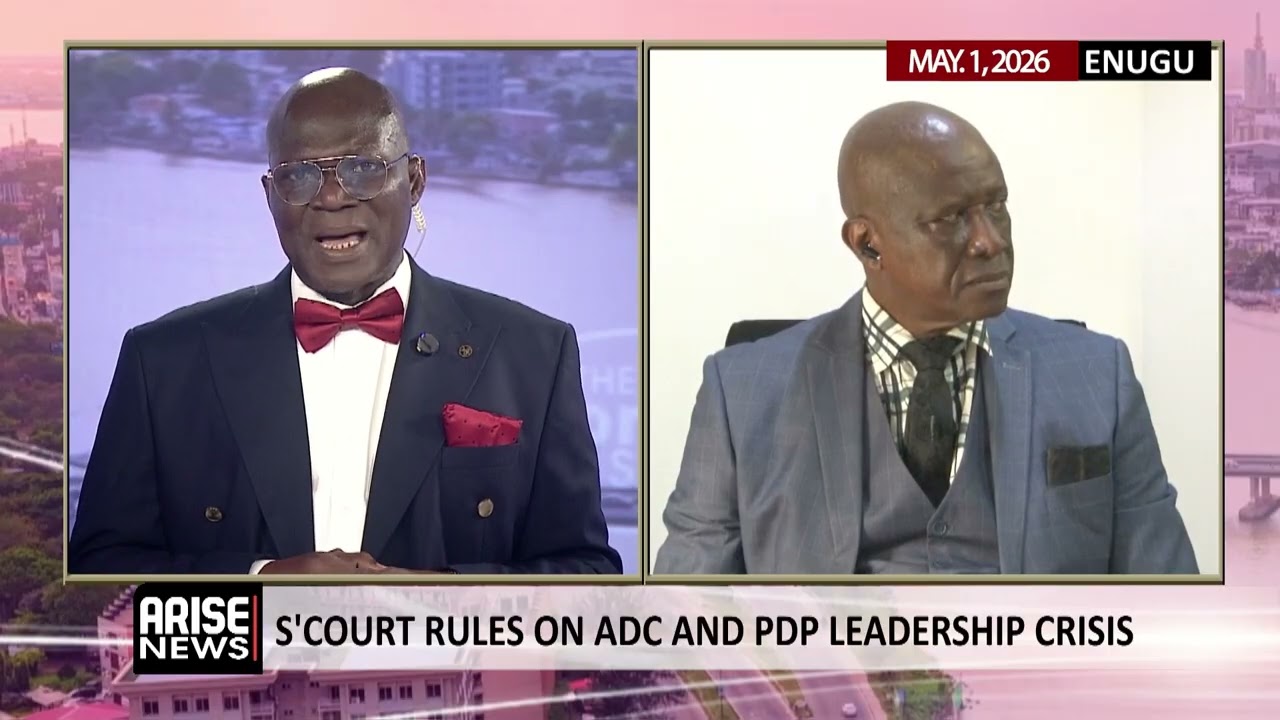

Senior Advocate of Nigeria, Oba Maduabuchi, has challenged the Court of Appeal’s handling of the ADC leadership dispute, raising questions about the court’s jurisdiction and the legal basis of its orders.
Speaking in an interview with ARISE NEWS in Friday, he stated that the ruling introduced directives that were not requested by any of the parties and shaped the trajectory of the case up to the Supreme Court, where key aspects were struck down.
“That main point, that the Court of Appeal did not have the powers or jurisdiction to make an order not sought by any of the parties was properly made by the Supreme Court.”
Maduabuchi said the case should not have reached the apex court. “The ADC had no business in the Supreme Court in the first place. This is because there was no decision of the Federal High Court that was appealable. The Court said, put them on notice, and they go to Court of Appeal, without even obtaining leave because it’s an interlocutory appeal. And the Court of Appeal says, go back and hear your case on the merits in full.”
He said there was no valid appeal before the appellate court. “The Court said, put them on notice, and they go to Court of Appeal, without even obtaining leave because it’s an interlocutory appeal. And the Court of Appeal says, my friend, go back and hear your case on the merits in full, once the Court said there is no valid appeal before us, it should just wash its hands off of them.”
Maduabuchi emphasised that the court instead went beyond its role. “In law, we say that courts are not Father Christmas. They do not give you what you didn’t ask for and what you do not merit. But somehow, the Court of Appeal, in making the proper decision that there was no valid appeal, now took a step further to say, maintain status quo.”
He said the Supreme Court addressed that issue directly. “That main point, that the Court of Appeal did not have the powers or jurisdiction to make an order not sought by any of the parties was properly made by the Supreme Court.”
On the order to maintain status quo, he said its meaning was specific. “Status quo ante bellum, before the commencement of hostilities.”
Maduabuchi mentioned the electoral body acted within that interpretation at the time. “When INEC acting on the order of the Court of Appeal removed David Mark, they were on solid ground.”
He stated that public officials are often criticised for following court orders. “Public officers are always criticised, but we do not give them accolades when they deserve it.”
On the PDP ruling, Maduabuchi said the Supreme Court settled the issue of leadership. “The PDP judgment settled the issue of nationalisation and who are the proper leaders of the PDP. It settled it conclusively.”
He said one faction was removed from the party structure. “You are not members of the party. You don’t have a right to speak for the party.”
Maduabuchi explained actions taken by that group have no effect. “Anything you’ve done, whether it is in terms of money, any letter you’ve written, was removed.”
He said the court focused on compliance with its orders. “One thing courts don’t tolerate is the defiance of its orders.”
On the ADC matter, he said the dispute remains before the lower court. “It cannot be rendered, it’s a living matter.”
On the issues before the court are separate, he said. “The issue of what happened in the state is different from who is occupying the position at the national level.”
On next steps, Maduabuchi pointed to internal resolution.
“They have already inflicted a wound upon themselves.”
He said repeated litigation is affecting party organisation. “You are chasing shadows, the other one is moving.”
Maduabuchi emphasised the time remains a factor. “You know that this thing is a question of time.”
On a separate suit seeking to deregister parties, he questioned its basis. “What is the locus of those that brought the matter?”
He said the legal framework has changed. “The current constitution of Nigeria is not that of last year.”
Maduabuchi framed the compliance must be judged under the current law. “The law became effective the day the new constitution, became effective the day the president signed the amendment.”
He said any claim of non-compliance must follow elections conducted under that law.
“Any fraction must be after that signing, not before.”
Erizia Rubyjeana