
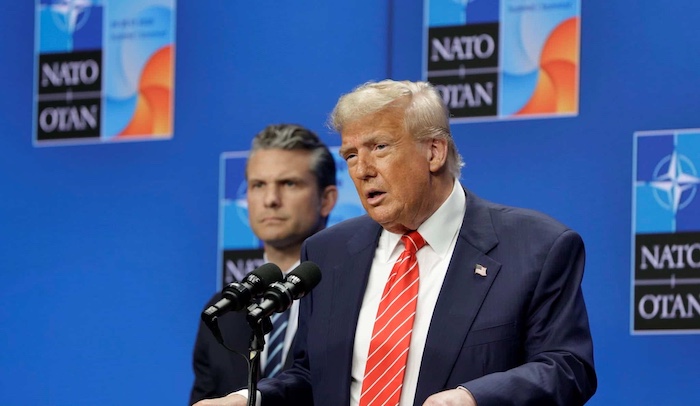
US President Donald Trump criticized NATO during a tense private meeting with its secretary-general Mark Rutte, as divisions within the alliance deepened over the war involving Iran.
The meeting, which lasted more than two hours at the White House, reportedly involved frank and direct exchanges between the two leaders. Speaking afterward, Rutte described the talks as open and candid, while acknowledging Trump’s frustration with several NATO allies. He noted that although disagreements were evident, the discussion had taken place between “two good friends.”
The criticism intensified after White House spokeswoman Karoline Leavitt quoted Trump as saying NATO had been “tested and they failed” during the Iran conflict. The remarks reflected growing dissatisfaction in Washington over what it viewed as insufficient support from European allies during the US military campaign.
Several NATO member states had resisted direct involvement in the conflict. According to officials, some countries denied US military aircraft access to their airspace, while others declined to deploy naval forces to help secure the strategically critical Strait of Hormuz, a key route for global energy shipments.
Although Rutte did not identify specific countries, he acknowledged that some alliance members had fallen short of expectations during the Iran operation. At the same time, he emphasized that a majority of European nations had contributed in various ways, suggesting a mixed response rather than a complete breakdown in cooperation.
Following the meeting, Trump reiterated his criticism in a post on Truth Social, stating that NATO had not supported the United States when needed and warning that such support might not materialise in the future. In recent weeks, he had repeatedly described the alliance as a “paper tiger” and raised the possibility of withdrawing the US from the 32-member bloc.
The dispute unfolded even as Trump had announced a temporary pause in attacks on Iran under a two-week ceasefire. Despite that development, the political fallout from the conflict continued to strain transatlantic relations, with diplomatic tensions showing little sign of easing.
Leavitt further underscored the administration’s position, accusing NATO countries of turning their backs on the American people despite benefiting from US-funded defense arrangements. She said Trump had intended to confront Rutte directly over burden-sharing and alliance commitments.
Trump also called on countries dependent on Gulf oil supplies to take greater responsibility in countering Iran’s influence over the Strait of Hormuz. However, European diplomats indicated that many nations were unlikely to participate in maritime security or mine-clearing operations while hostilities persisted.
The disagreement marked what analysts described as a critical moment for NATO. Oana Lungescu, now with the Royal United Services Institute, warned that the alliance had reached a “dangerous point” amid rising geopolitical pressures.
The tensions over Iran compounded existing disagreements on issues such as Ukraine, defense spending, and US foreign policy priorities. Trump’s stance on Russia, criticism of Ukraine, and past remarks about Greenland had already unsettled European allies.
Despite the strain, US officials privately reassured European governments that Washington remained committed to NATO. Meanwhile, Rutte sought to maintain dialogue and explore deeper defense cooperation, including discussions on both the Iran conflict and the war in Ukraine.
Erizia Rubyjeana