
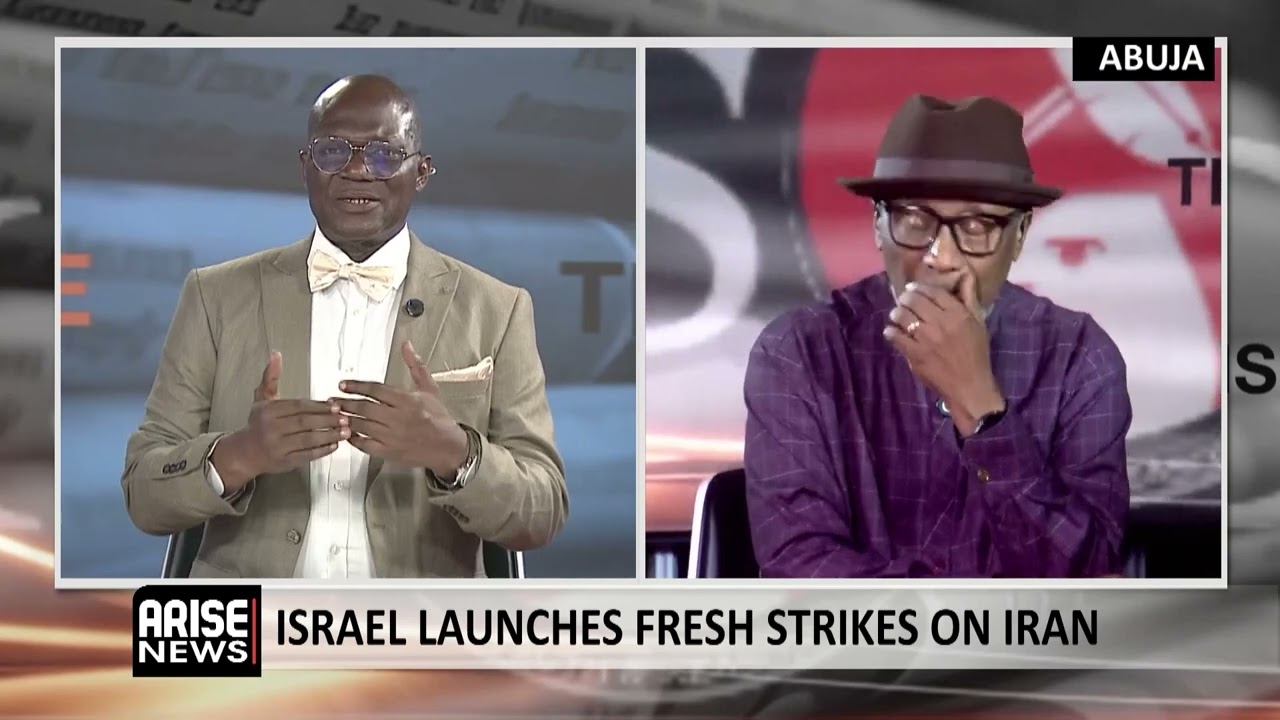
A former Nigerian diplomat, Joe Keshi, has said Iran was never a direct threat to the United States, arguing that the current escalation in the Middle East is largely the result of Israel’s longstanding desire to confront Tehran.
Speaking in an interview on ARISE News, Keshi said the latest strikes on Iran reflect years of pressure from Israeli leadership rather than an immediate security threat to Washington.
“Iran was not a threat to the United States in any way. Yes, it was supporting some groups in the region, but it was not a threat to the United States, except that Netanyahu has always wanted to go after Iran.”
The crisis intensified after the United States and Israel launched major strikes on Iran, with Ali Khamenei reportedly killed during the assault, escalating tensions across the Middle East and prompting fears of wider regional conflict.
Keshi argued that the current confrontation can be traced back to the decision by Donald Trump to withdraw from the Iran nuclear agreement negotiated under Barack Obama.
According to him, the deal had been functioning effectively before it was scrapped.
“Four or five years ago, Donald Trump cancelled the Iranian deal made by Obama, which by the way was working perfectly well.”
He said the International Atomic Energy Agency had consistently confirmed Iran’s compliance with the agreement.
“The International Atomic Energy Agency was periodically monitoring Iran and issuing reports that they were complying with the agreement that Obama signed.”
Keshi suggested Trump cancelled the deal partly because of political motivations and pressure from Israel.
“Donald Trump cancelled it for two reasons. One, because of Israeli pressure. Netanyahu is a very good friend. Secondly, Trump did not want anything associated with Obama to remain.”
Keshi also criticised what he described as attempts by Washington to force regime change in Iran through military action.
“They are killing the leaders of Iran in an attempt to enforce regime change. America has attempted regime change so many times and it has failed.”
He cited examples including Afghanistan, Iraq and Libya.
“Afghanistan is a typical example. Libya is a typical example. Iraq is also a typical example.”
According to him, regime change cannot be achieved through air strikes alone.
“Regime change has never succeeded from the air, and I’m not too sure this one will succeed.”
He added that the quick replacement of Iranian leaders already suggests the strategy may fail.
“The immediate replacement of those that have been killed is a clear indication that the desire for regime change is already on its way to failure.”
Keshi warned that global tensions are rising because major powers increasingly act without regard for international rules.
“The world is in this state because of the irresponsibility of world powers who think that because they are powerful they can do whatever they want within the international system.”
He said both Russia’s war in Ukraine and the US-Israel strikes on Iran illustrate the erosion of global diplomatic norms.
“You have the Russians attacking Ukraine, and today you have the United States and Israel doing whatever they want to do.”
According to him, such actions are weakening the authority of the United Nations.
“They are not only endangering world peace, they have virtually rendered the United Nations almost impotent.”
Keshi also questioned the legitimacy of preventing Iran from developing nuclear capability when other countries possess nuclear weapons.
“India has nuclear power. Pakistan is a nuclear power. North Korea continues to build its nuclear capability, and nobody attacks them.”
He said the real objective is to ensure Israel remains the dominant military power in the region.
“Israel simply wants to ensure that there is no power strong enough in the Middle East to pose a threat to it.”
Keshi also pointed out that Israel itself is widely believed to possess nuclear capability.
“The whole world knows that Israel has military capability, but nobody wants to talk about it.”
Despite the escalating conflicts globally, Keshi rejected suggestions that diplomacy is becoming irrelevant.
“It is not the end of diplomacy. Diplomacy requires patience.”
He argued that successful diplomacy often involves prolonged negotiations conducted quietly behind the scenes.
“Diplomacy takes a long time. You need patience to get people to agree, especially when they are bitter enemies.”
Keshi contrasted current diplomatic efforts with earlier negotiations led by figures such as Henry Kissinger, which relied on sustained and discreet engagement.
“Kissinger travelled secretly across the region negotiating until he found common ground before bringing everyone to the table.”
Keshi urged the international community to strengthen global institutions to prevent unilateral actions by powerful countries.
“The rest of the world should find a way to strengthen the United Nations so that it can get involved quickly in negotiations.”
Without stronger international mediation, he warned, global stability will remain vulnerable to the decisions of powerful states.
“We are now at the mercy of superpowers exerting their power and deciding how the world should go.”
Boluwatife Enome