
In a country where the average citizen is currently grappling with the complexities of new tax reforms, news of high-level financial misconduct hits like a lightning bolt. For weeks, the Nigerian digital space has been buzzing with a headline that seems almost impossible: How a 7 billion Naira scandal was allegedly carried out by FIRS Chairman Zack Adedeji in just one month.
At a time when the Federal Inland Revenue Service (FIRS) is asking Nigerians to tighten their belts and embrace a new fiscal era, these allegations have sparked a firestorm of debate. If the man at the helm of our national revenue collection is allegedly presiding over a system syphoning billions, where does that leave the struggling taxpayer?
The Allegations Against FIRS Chairman Zack Adedeji
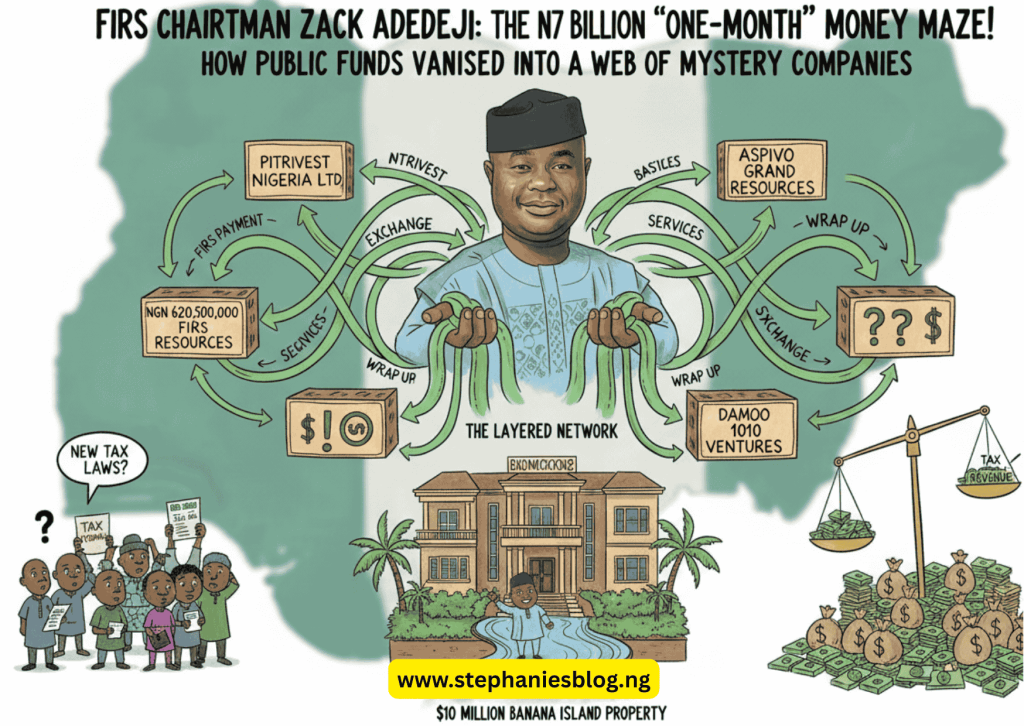
The core of the controversy centers on a staggering sum of 7 billion naira. According to investigative reports and leaked financial summaries, this massive amount was allegedly moved through a network of suspicious corporate entities within a very short window.
To the layman, 7 billion naira is a figure that can fund entire local government areas for a year. However, for it to be linked to the FIRS Chairman Zack Adedeji administration as a “one-month” feat of financial engineering is what makes this story so compelling and so terrifying for the Nigerian economy.
The allegations don’t stop at liquid cash. Whispers from the corridors of power in Abuja suggest a lifestyle that far outpaces a public servant’s salary. Most notable is the alleged purchase of a $10 million property in Banana Island, Lagos. In today’s exchange rate, that is upwards of 15 billion naira. If true, the question on everyone’s lips is simple: Where did the money come from?
Inside the Paper Trail: The Pitrivest Connection
Recent forensic reports have shed light on exactly how these funds are allegedly moved. At the center of the web is an entity known as Pitrivest Nigeria Limited. This company, along with others like Aspivo Grand Resources Nig Ltd and Damoo 1010 Ventures, reportedly functions as a high-volume “pass-through” for funds.
The pattern is a classic example of “layering”, which is a money laundering technique where money is moved rapidly between accounts to hide its origin. Key findings include:
- Direct Government Links: On March 18, 2025, a credit of NGN 620,500,000 was sent directly from the “Federal Inland Revenue” to Pitrivest via Remita.
- Rapid Outflows: Almost immediately after receiving the FIRS funds, NGN 250 million was moved out of the account on the same day.
- Vague Descriptions: Multi-million naira transfers were labeled with suspicious and vague terms like “Exchange,” “Services,” “Wrap Up,” and “Mediation.”
Below is a detail of the financial trail
For many, this looks less like legitimate government business and more like a sophisticated scheme to divert public funds into private pockets under the watch of FIRS Chairman Zack Adedeji.
Understanding the Timing of the FIRS Chairman Zack Adedeji Controversy
Timing is everything in politics and finance. Currently, Nigeria is undergoing a massive shift in its tax laws. The government is pushing for a more “taxpayer-centric” model, yet many small business owners and low-income earners are terrified of what these new laws mean for their survival.
When the FIRS Chairman Zack Adedeji stands on a podium to talk about “tax equity,” but his agency is linked to 7 billion naira scandals involving obscure companies in Kaduna, it creates a massive trust deficit. Nigerians are asking:
- Are we being taxed to fund luxury villas in Banana Island?
- Is the “digitalization” of the FIRS just a screen for more sophisticated leakages?
- Why is a general trading company receiving over 600 million naira from the tax office for “mediation”?
The “One-Month” Mystery: How Could It Happen?
The most shocking part of this narrative is the velocity. Carrying out a 7 billion naira scandal in such a short timeframe requires either a total breakdown of internal checks or a very high level of systemic cooperation.
Reports suggest that these companies—Pitrivest, Aspivo, and Damoo—operate as a single operational network. By moving round-figure sums (which is a major red flag for auditors), the entities create a “financial fog.” This fog makes it difficult for regulators to see that the money being collected from hardworking Nigerians is allegedly being funneled toward “Ultimate Beneficiaries” who have yet to be fully unmasked.
The Other Side: Is This a Campaign of Calumny?
In the interest of fairness, it must be noted that the FIRS Chairman Zack Adedeji has his defenders. Many argue that these allegations are a “smear campaign” designed to stop the aggressive tax collection reforms currently underway.
Supporters point to the fact that the FIRS has seen record-breaking collection figures under his leadership. They claim that those who benefited from the previous “leaky” system are now fighting back by inventing stories of $10 million mansions and fraudulent transfers. Some Civil Society Organizations (CSOs) that initially protested have even retracted their statements, claiming they were misled by “unverified information.” But judging from all the evidence that we have, this news carries water.
What This Means for the Nigerian Taxpayer
Regardless of the defense, the evidence of the Pitrivest transactions remains a matter of public concern. You cannot ask a man who can barely afford a bag of rice to pay more tax while he reads about massive, unexplained transfers to private entities.
If FIRS Chairman Zack Adedeji is to maintain credibility, there must be a transparent, forensic audit of every kobo paid to these “General Trading” firms. Nigerians are no longer satisfied with simple denials; they want to see the contracts, the services rendered, and the justification for such massive payments.
Conclusion: The Need for Accountability
As the call for a full investigation grows louder, the fate of the FIRS Chairman Zack Adedeji hangs in the balance. Will he be remembered as the reformer who modernized Nigeria’s tax system, or as the man who presided over a 7 billion naira disappearance in just one month?
In a country tired of “business as usual,” we deserve more than just rhetoric. We deserve a tax system that is as clean at the top as it is demanding at the bottom.