
Senior US Democrats have sought to reassure European allies that President Donald Trump’s tenure is temporary, telling leaders at the Munich Security Summit that transatlantic relations will endure beyond his presidency.
US Secretary of State Marco Rubio was the focus of attention at the summit, as European officials waited to gauge the tone of his remarks. While his speech did not entirely calm anxieties, it was widely viewed as an attempt to signal that US ties with Europe, though strained, would not collapse.
But Rubio was not the only American voice in Munich.
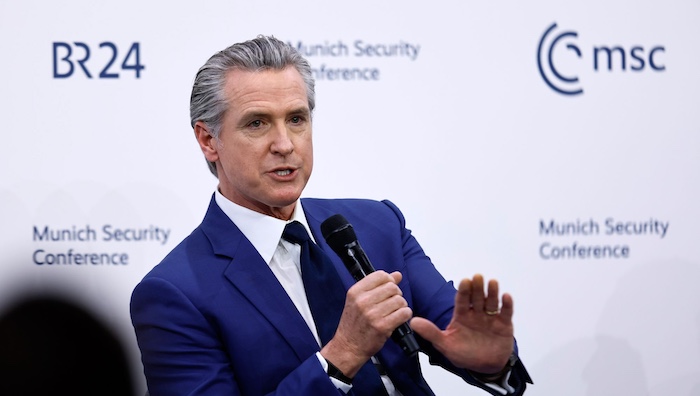
California Governor Gavin Newsom delivered one of the clearest messages to European leaders, saying: “If there’s nothing else I can communicate today, Donald Trump is temporary. He’ll be gone in three years.”
Newsom was among dozens of US governors and lawmakers attending the summit, including several Democrats widely seen as potential contenders for their party’s 2028 presidential nomination.
Democratic Senator Jeanne Shaheen of New Hampshire said: “The reason we’re here is to provide reassurance that we understand how important our European allies are.”
Republican Senator Thom Tillis struck a similar note, insisting the US and Europe were not in a “civil war” and urging allies not to be consumed by the “rhetoric of American politics”.
Concerns among European leaders have intensified amid Trump’s imposition of steep tariffs on trading partners and his administration’s push to reshape the international order. His renewed remarks about Greenland before departing Washington for Florida were viewed as another example of a more assertive foreign policy posture.
Democrats in Munich also raised alarms about domestic developments in the US.
Virginia Senator Mark Warner warned that proposals to nationalise elections and impose stricter voter identification requirements by executive order could threaten the integrity of November’s midterm elections.
“I never thought I would say that in 2026 America,” he said.
Senator Elissa Slotkin described the political climate at home as turbulent, saying America was “going through something profound”, before adding, “We’ll get through it.”
Congresswoman Alexandria Ocasio-Cortez, one of the most prominent figures at the summit outside Rubio, linked economic inequality to the rise of authoritarian governments.
“It is of the utmost urgency that we get our economic houses in order and deliver material gains for the working class,” she said. “Otherwise, we will fall into a more isolated world governed by authoritarians who also do not deliver to working people.”
Arizona Senator Ruben Gallego underscored the broader Democratic message to Europe: “Right now, Europe just wants us to be better, right? And I think this has been a very good conference to reassure nerves. Sometimes you have to remind them that this is not all Trump … We’re still here.”
While Rubio sought to smooth tensions, Democratic leaders in Munich aimed to offer a clearer counterpoint to Trump’s America First approach, stressing that the US commitment to Europe extends beyond one presidency.
Faridah Abdulkadiri